
Small businesses in Miami face a unique set of challenges when it comes to managing employee benefits. Among them, paid sick leave stands out as both a compliance requirement and a retention tool.
Navigating the balance between business costs and employee well-being requires more than good intentions, it calls for a structured approach that integrates human resources, payroll, and financial management.
This is where professional bookkeeping services miami add significant value, ensuring that policies are not only fair but also accurately tracked, compliant, and financially sustainable.
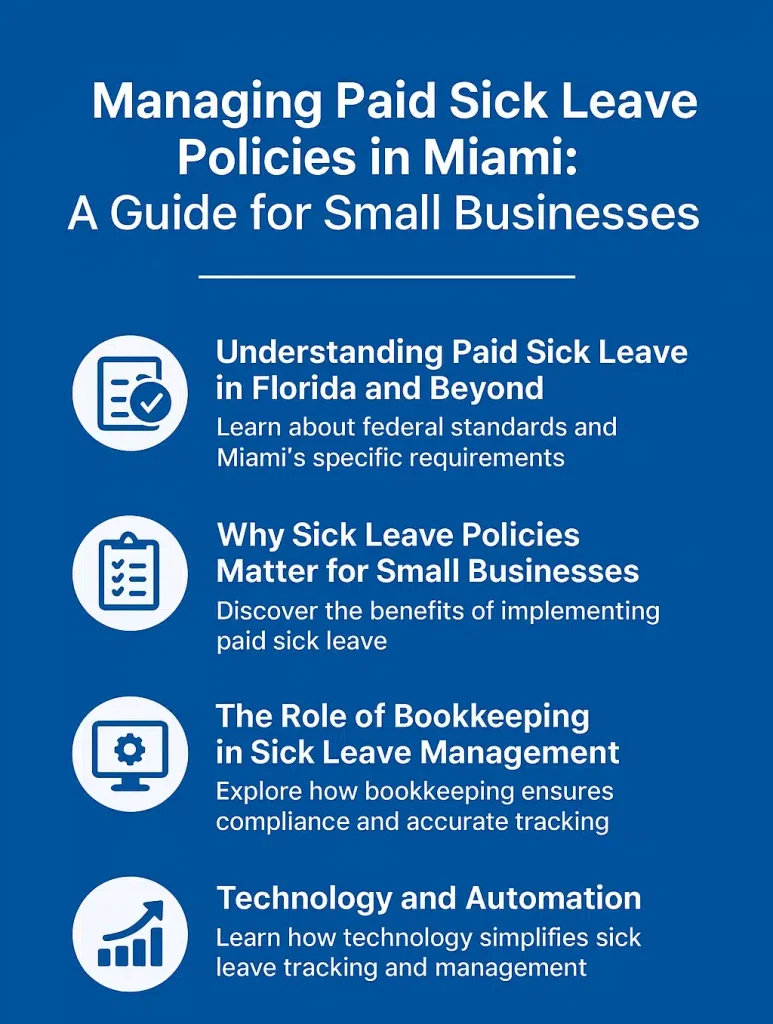
Understanding Paid Sick Leave in Florida and Beyond
Florida does not have a statewide paid sick leave law. Instead, businesses in Miami operate under federal standards, including the Family and Medical Leave Act (FMLA), as well as guidelines established by the Department of Labor (DOL).
In the absence of a state mandate, many small businesses choose to design internal paid sick leave policies as a way to remain competitive in attracting and retaining talent.
According to the U.S. Bureau of Labor Statistics, around 78% of private-sector workers nationwide have access to some form of paid sick leave.
The challenge for Miami small businesses is that even though they may not be legally required to offer sick leave, failing to do so can result in higher turnover, lower employee morale, and productivity loss.
With a competitive labor market, especially in industries like hospitality, construction, and retail, offering structured sick leave policies is becoming less of an option and more of a necessity.
Why Sick Leave Policies Matter for Small Businesses
For small business owners, the decision to provide paid sick leave is about more than employee satisfaction. It directly impacts profitability and compliance.
I’ll employees coming to work risk spreading illness, reducing overall productivity and increasing healthcare costs.
On the other hand, without a clear sick leave policy, businesses may face disputes, payroll mismanagement, or errors in recordkeeping that complicate tax filings and audits.
This is why integrating HR strategy with bookkeeping is essential. Proper bookkeeping ensures that sick leave accruals are correctly tracked, employee usage is logged, and payroll systems reflect accurate balances.
In practice, this integration helps business owners answer critical questions: How much sick leave liability is on the books?
Designing a Paid Sick Leave Policy
The first step for any small business in Miami is to clearly define the scope of their sick leave policy. This includes determining accrual methods, eligibility requirements, and carryover rules.
While some businesses opt for a set number of days per year, others implement an accrual system where employees earn a certain number of hours per pay period worked.
Regardless of structure, policies must be transparent and consistently applied. For example, restaurants or construction firms with seasonal staff may need different accrual rules than offices with long-term employees.
Employers must also decide whether unused sick leave can be carried over into the next calendar year or if it resets annually.
This process requires both HR insight and bookkeeping precision. Payroll software must be programmed to calculate accruals accurately, while bookkeeping teams ensure financial statements reflect the liability of unused sick days.
For small businesses, outsourcing this function to professionals can help avoid costly errors.
For guidance on selecting payroll tools that align with leave management, we offer a resource on selecting payroll software for Miami businesses.
Compliance and Legal Considerations
While Florida does not impose statewide paid sick leave, Miami businesses must still comply with federal requirements and industry-specific obligations. For instance, the Occupational Safety and Health Administration (OSHA) expects employers to maintain safe work environments, which includes encouraging sick employees to stay home.
During health emergencies, such as COVID-19, federal laws have temporarily mandated sick leave benefits for certain workers.
Failing to properly document and manage sick leave can lead to disputes and penalties.
According to the U.S. Department of Labor, employers must maintain accurate wage and hour records, including time off. This means payroll and bookkeeping systems must capture leave data consistently and correctly.
The Role of Bookkeeping in Sick Leave Management
Effective sick leave management goes far beyond HR policy. Bookkeeping ensures that sick leave is accurately represented in financial records.
This includes recording liabilities for accrued but unused sick time, adjusting payroll accounts for absences, and providing management reports that show the financial impact of sick leave.
For small businesses, these insights are critical. For example, a retail shop might realize that rising sick leave usage during peak holiday seasons impacts staffing costs and profitability.
With accurate bookkeeping, the business can forecast labor expenses more effectively, reallocate staff, or adjust budgets in anticipation of seasonal absences.
At Profitline, our team specializes in integrating HR and bookkeeping processes.
We recently discussed this in our guide to pay transparency for small businesses in Miami, highlighting how proper recordkeeping promotes both compliance and trust.
Building a Culture of Trust and Compliance
Paid sick leave is not only a financial matter but also a cultural one. Businesses that provide clear, well-managed policies create a workplace where employees feel valued and secure.
This, in turn, reduces absenteeism, enhances productivity, and fosters loyalty.
Miami’s diverse workforce means that small businesses must be especially mindful of how policies are communicated.
Providing policies in multiple languages, maintaining accessible records, and ensuring fairness across different employee groups are all critical to building trust.
By linking HR policy with bookkeeping transparency, businesses create a system where both employees and employers benefit.
Staff know their sick leave is accurately tracked, and owners gain clear visibility into costs and compliance.
What’s Next?
Paid sick leave policies are more than a compliance checkbox—they are a strategic tool for small businesses in Miami.
By designing fair policies, ensuring accurate bookkeeping, and leveraging technology, business owners can balance employee well-being with financial sustainability.
Our expertise in bookkeeping services ensures that your sick leave policies are seamlessly integrated into your payroll and financial systems.
From tracking accruals to preparing compliant reports, we provide the support you need to keep your business running smoothly.
Ready to manage sick leave with confidence?
Contact us today for a free consultation and discover how our team can simplify your bookkeeping and HR processes!