
As a provider of bookkeeping services miami, we know how essential it is for local businesses to establish clear and efficient policies—including paid sick leave.
While Florida law doesn’t require private employers to offer paid sick days, many business owners in Miami are adopting them as a strategic tool to retain talent, improve productivity, and align with Miami-Dade’s local requirements where applicable.
This guide explains the legal framework, shows how to build a clean, fair policy, and outlines how to integrate sick-leave tracking with your bookkeeping and payroll workflows.
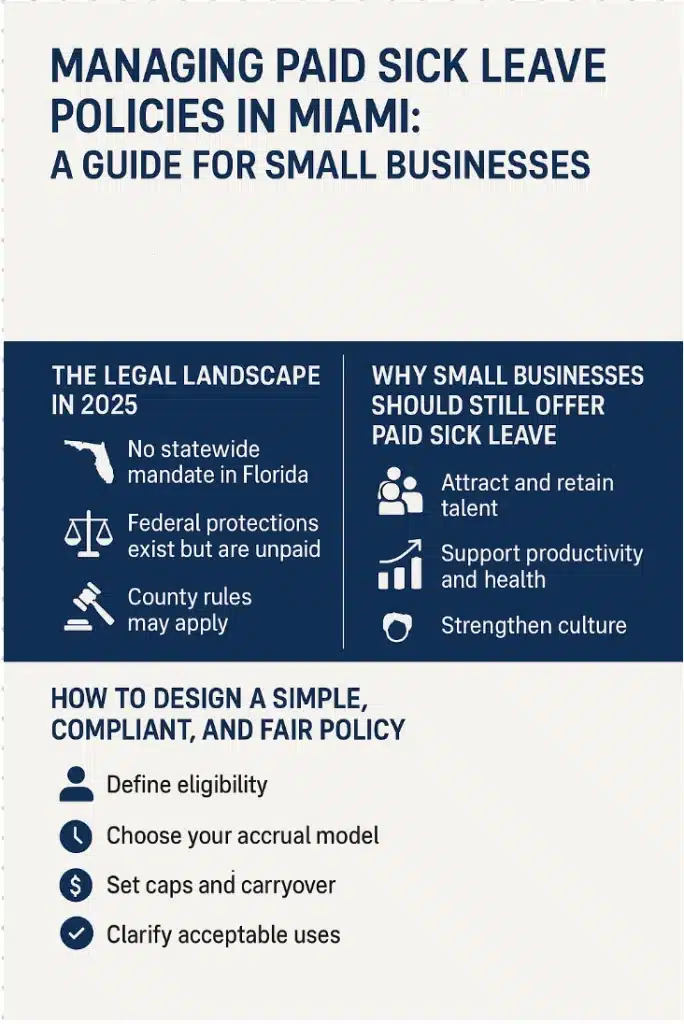
1) The Legal Landscape in 2025
Florida does not currently require private employers to provide paid sick leave, and payment for unused sick time is only required if your own policy or contract promises it.
Federal protections exist but are unpaid. The Family and Medical Leave Act (FMLA) provides up to 12 weeks of unpaid, job-protected leave for eligible employees at companies with 50+ employees.
Miami-Dade County requires paid sick leave for certain county contractors, including either accrual at 1 hour per 30 hours worked or an upfront 56-hour grant, plus documentation, notice, and anti-retaliation provisions.
2) Why Small Businesses Should Still Offer Paid Sick Leave
Even if you are not legally required, a thoughtful policy is good business:
-
Attract and retain talent. Florida employers increasingly offer sick leave; a competitive benefits package reduces turnover.
-
Support productivity and health. Allowing sick employees to recover at home reduces contagion and burnout.
-
Strengthen culture. Clear, fair rules signal that you value employees and their families—boosting morale and loyalty.
3) How to Design a Simple, Compliant, and Fair Policy
a) Define eligibility
Specify whether the policy covers full-time, part-time, and temporary staff, and whether there’s a waiting period before accrual begins.
b) Choose your accrual model
-
Accrual: 1 hour per 30 hours worked (mirrors Miami-Dade’s contractor standard).
-
Frontloading: Grant a fixed annual bank (e.g., 56 hours) at the start of the benefit year.
c) Set caps and carryover
Decide whether unused hours roll into the next year and set a reasonable cap to limit liability.
d) Clarify acceptable uses
State that paid sick leave can be used for personal illness or injury, preventive care, mental health, and caring for immediate family members.
e) Documentation expectations
Many employers request a medical note after 3+ consecutive days. Spell this out to avoid confusion.
f) Request/notice procedures
Outline how employees should notify managers and how far in advance (e.g., 3 days for foreseeable appointments).
g) Recordkeeping and payroll alignment
Use digital systems to track accruals and usage precisely; integrate with payroll and your bookkeeping so balances and wage calculations stay accurate.
4) Integrate Sick Leave With Your Payroll Stack (and Choose the Right Tools)
Sick-leave policy design should align with your payroll software and accounting flow. If your current tools make tracking balances or exporting reports painful, it may be time to reassess your stack.
For a practical framework on evaluating and switching tools, read our guide: Selecting Payroll Software for Miami Businesses.
That post walks through vendor comparison criteria (cost, tax support, PTO modules, integrations) and common pitfalls when migrating.
Selecting the right system upfront will save you hours every month and reduce compliance risk.
5) Communication Matters: Link Sick Leave and Pay Transparency
Sick-leave rules don’t live in a vacuum—employees understand and trust policies when they’re communicated alongside compensation standards.
If you’re rolling out or updating sick leave, consider addressing pay and promotion clarity in the same package.
For a practical, Miami-focused primer on transparent compensation practices, see: Pay Transparency in Miami: A Guide for Small Businesses.
Publishing clear FAQs (how accrual works, what happens on separation, how to request time) reduces rumor mills and ensures managers apply the policy consistently.
6) How Professional Bookkeeping Makes Sick Leave Easy
At Profitline, our team goes beyond categorizing transactions.
We help you operationalize your policy:
-
Seamless payroll sync: We align your policy rules (accrual, carryover, caps) with payroll to avoid miscalculations.
-
Clean general-ledger mapping: Paid sick hours post to the right expense accounts for accurate P&L reporting.
-
Audit-ready documentation: Centralized records of balances, requests, approvals, and notes.
-
Budgeting and forecasting: Monthly dashboards reveal usage trends, seasonal spikes, and cost projections so you can staff smartly.
Because your sick-leave policy touches wages, taxes, and benefits, pairing it with expert bookkeeping prevents compliance gaps and surprise costs.
Get a free consultation today with our Miami team!
7) Best-Practice Playbook
-
Keep it short. Policy docs should be easy to scan: eligibility, accrual, use cases, documentation, request process, carryover, caps.
-
Train managers. Run a 30-minute huddle on scenarios (last-minute illness, overlapping requests, documentation timing).
-
Use one source of truth. Store the policy and balances in the same system everyone can access (HRIS/Payroll).
-
Automate alerts. Trigger emails when employees near caps or when documentation is due.
-
Review annually. Reassess against updated county rules and federal guidance.
-
Measure impact. Track absenteeism, overtime, and turnover before/after rollout.
What’s Next?
Managing paid sick leave is more than a policy document—it’s a system that touches payroll, compliance, staffing, and culture.
When it’s designed simply and wired into your bookkeeping and payroll, it becomes a strategic advantage: fewer errors, happier teams, cleaner books.
Ready to launch (or fix) your paid sick leave policy and wire it into your accounting?
Contact us today! We’ll align your policy, payroll, and bookkeeping so every hour and every dollar lands where it should.
Let’s make compliance effortless.