
In Miami’s fast-paced construction industry, accurate bookkeeping is more than a back-office function—it’s the backbone of profitability and compliance.
With projects that span months or even years, milestone-based billing, subcontractor reliance, and strict local regulations, generic accounting solutions simply fall short.
This is where specialized bookkeeping services miami make the difference. In this article, we’ll explore the unique financial challenges construction companies face and how the right bookkeeping approach ensures long-term success.
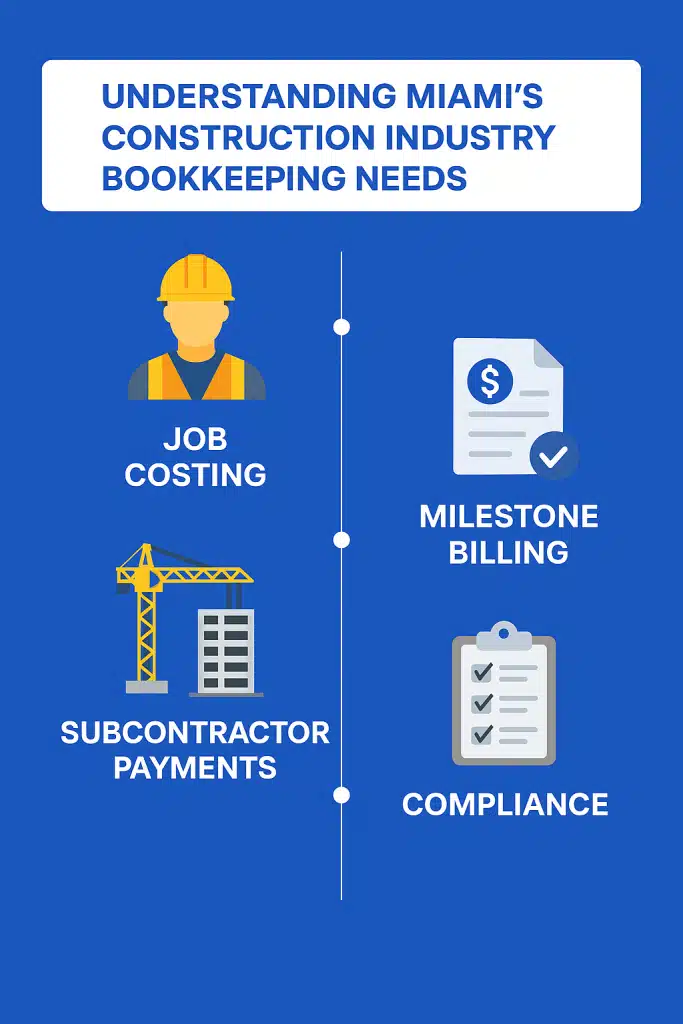
1. The Complexity of Job Costing
Every construction project is essentially a business of its own. Materials, labor, subcontractors, permits, and equipment rentals must be tracked with precision.
Job costing allows construction companies to:
-
Understand the true profitability of each project.
-
Identify areas where costs are exceeding budgets.
-
Adjust bids and pricing strategies for future projects.
According to industry research, poor job costing can drain thousands of dollars per project, while companies that implement accurate tracking improve profitability and decision-making dramatically.
2. Milestone Billing, Retainage, and Cash Flow
Unlike most industries where billing is straightforward, construction relies on milestone-based invoices, progress payments, and retainage (a percentage withheld until project completion).
-
Contractors that fail to track retainage properly risk losing up to 20% of their receivables.
-
Retainage management also directly impacts cash flow and payroll stability.
-
Bookkeeping systems designed for construction can ensure contractors recover the majority of retained earnings on time.
Efficient bookkeeping ensures invoices match contractual terms, retainage is collected, and cash flow supports ongoing operations.
3. Choosing the Right Accounting Method
Construction companies often rely on two accounting methods:
-
Percentage of Completion: Recognizes revenue and expenses as a project progresses, providing accurate financial visibility.
-
Completed Contract Method: Records revenue only once a project is finished—useful for short-term jobs but risky for long-term projects.
Selecting the wrong method can distort a company’s financial health, making compliance and financing more challenging.
Bookkeeping comes with complex challenges, trust our Miami team to handle them with precision. We’ll implement the right system to keep your finances accurate, compliant, and stress-free.
4. Documentation and Audit Readiness
Construction firms are frequently subject to audits, disputes, and compliance checks.
Bookkeeping that organizes and digitizes documentation—contracts, receipts, lien waivers, and change orders—offers critical advantages:
-
Faster dispute resolution.
-
Smoother bonding and licensing processes.
-
Time savings of 7–10 hours per week for administrative teams.
5. Subcontractors, Compliance, and Worker Classification
Miami construction relies heavily on subcontractors. Misclassifying workers as independent contractors rather than employees can lead to lawsuits, IRS penalties, and back taxes.
Bookkeeping systems must accurately:
-
Track subcontractor agreements and payments.
-
Generate correct IRS forms (1099-NEC vs. W-2).
-
Ensure compliance with both state and federal employment laws.
6. Insurance Costs and Contractual Obligations
Insurance is another layer of complexity:
-
Florida requires workers’ compensation insurance for construction companies, with penalties reaching $1,000 per day for noncompliance.
-
Liability coverage, builder’s risk, and fleet insurance must be tracked and paid on time.
-
Bookkeeping ensures that renewals don’t lapse and premiums are accurately allocated to projects
Learn how to improve payroll efficiency: Selecting Payroll Software for Miami Businesses.
7. Local Regulations and Licensing in Miami-Dade
Beyond state and federal rules, Miami-Dade imposes:
-
Tangible property tax filings for equipment and tools.
Late or inaccurate filings lead to fines and project delays. Bookkeeping that integrates local compliance deadlines helps businesses stay ahead.
Also, explore the benefits of pay transparency in your organization: Pay Transparency Miami Guide for Small Businesses.
8. The Role of Technology and Construction-Specific Software
Generic accounting tools are rarely enough for construction. Specialized solutions integrate:
-
Job costing modules.
-
Retainage tracking.
-
Progress billing automation.
-
Field management integration.
Studies show automation can cut bookkeeping data entry time by 50% while reducing reporting errors (source).
9. Why Outsourcing Bookkeeping in Miami Makes Sense
For growing construction firms, outsourcing bookkeeping ensures:
-
Dedicated expertise in construction accounting.
-
Accurate payroll, compliance, and tax reporting.
-
Reduced risk of fines and missed payments.
-
Freedom to focus on project management and client relationships.
Industry specialists like our tailor bookkeeping to the construction sector, offering accounts payable/receivable management, payroll support, compliance assistance, and strategic financial insights.
What’s Next?
The construction industry in Miami doesn’t just need standard bookkeeping—it needs a specialized financial partner that understands job costing, retainage, compliance, and subcontractor management.
By aligning bookkeeping practices with construction realities, your business can achieve healthier cash flow, better compliance, and long-term growth.
Ready to build stronger financial foundations for your projects?
Contact us today for a free consultation and discover how our expert bookkeeping team can keep your construction business compliant, profitable, and prepared for the future.