
In today’s fast-paced business world, leveraging bookkeeping Houston expertise with HR functions is no longer optional—it’s essential.
Many companies in Houston recognize that integrating HR and bookkeeping eliminates redundancies, improves compliance, and boosts both financial and workforce management.
But how can your business make this shift, and what gains can you expect? Let’s dive in.

Why HR and Bookkeeping Were Traditionally Separate
1. Distinct Roles with Shared Data
Historically, HR and bookkeeping operated in silos: HR managed hiring, onboarding, benefits, and performance, while bookkeeping tracked expenditures, payroll, taxes, and financial records.
However, both functions rely heavily on the same employee and payroll data—raising duplicated work and data integrity issues.
2. Compliance Complexity
Ever-shifting regulations—such as labor laws, tax rules, and benefits reporting—require coordination between HR and accounting.
A lack of integration can lead to missed deadlines, penalties, and stress for business owners.
3. The Small-Business Imperative
For small and mid-sized businesses (SMBs), resource constraints make efficient, automated integration a game changer.
When HR and bookkeeping are connected, businesses save hours of manual tasks and gain better financial visibility.
Four Key Benefits of HR & Bookkeeping Integration
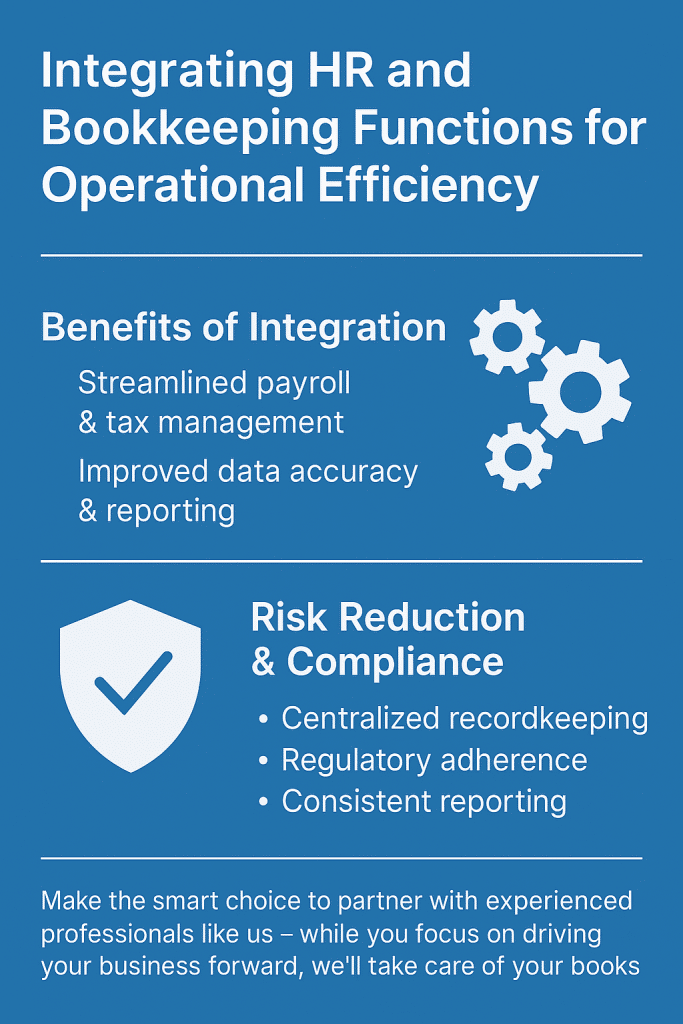
1. Streamlined Payroll & Tax Management
By syncing HR systems and accounting tools, payroll calculations—such as hours worked, overtime, benefits, and deductions—feed directly into your bookkeeping.
This significantly reduces manual input and errors and speeds up tax filing processes.
2. Improved Data Accuracy & Reporting
Integrated systems ensure updates—such as new hires, benefits adjustments, or pay changes—are reflected automatically across HR and financial platforms.
That reduces the risk of discrepancies in W‑2s, 1099s, and cash-flow reports.
3. Smarter Labor Cost Insights
When labor data sits alongside financial data, you can measure departmental labor costs, forecast cash needs, and optimize staffing strategies.
That empowers informed decision-making for operations and budgeting.
4. Accelerated Onboarding/Offboarding
Integration automates repetitive tasks—new hire paperwork, benefits enrollment, payroll setup, access provisioning, and termination offboarding—saving time and reducing risk.
Thinking about cutting manual tasks? Let us handle your bookkeeping and HR process that works seamlessly for your business.
Tools & Software to Power Your Integration
There’s an ever-growing suite of cloud solutions that support HR-accounting integration.
Key tools include:
-
QuickBooks Online & Xero – industry‑leading bookkeeping platforms with add‑ons and app ecosystems.
-
Gusto, BambooHR, ADP – HR software with built‑in payroll modules and API integrations.
-
Rippling & Paychex Flex – unified platforms that combine HRIS, payroll, benefits, and time-tracking.
These solutions automate tax filings, PTO accruals, expense reimbursements, and employee portals—all while enforcing role-based access for security.
As data protection becomes critical, check out our post on Ensuring Data Security in Payroll & HR for in-depth tips on safeguarding your systems.
Mitigating Risk & Strengthening Compliance
When HR and bookkeeping data are unified, your business gains consistency, transparency, and audit readiness:
-
Centralized Recordkeeping: Audit trails from recruitment to termination and payroll events are time-stamped and stored securely.
-
Regulatory Adherence: Automated tracking ensures you’re meeting wage laws, overtime rules, tax filings, and benefits notices.
-
Consistent Reporting: Generate unified reports for labor expenses, tax liabilities, and workforce metrics with just a few clicks.
Looking for legal-proof HR systems? We cover that in our blog on HR Compliance Strategies in Houston—a must-read for ensuring business compliance and reducing risk in Texas.
A Real-World Example: A Houston-Based Retailer
Meet “Bayou Boutique,” a fictional Houston retail shop with 30 employees. They faced monthly payroll delays, mismatched tax filings, and chaotic onboarding practices.
Challenges:
-
Manual timesheet logging and payroll entries
-
Frequent labor-cost errors affecting budgeting
-
Overlooked benefit elections and filings
Our Solution:
-
Implemented QuickBooks Online paired with BambooHR and Gusto
-
Automated payroll, PTO accruals, and benefits enrollment
-
Centralized financial and HR data
-
Set custom alerts for compliance deadlines
Results:
-
Payroll completed 50% faster, with zero manual errors
-
Monthly labor-cost reporting became automated
-
Compliance penalties were eliminated
-
Leadership gained actionable insights into labor spending
Best Practices for Seamless Integration
-
Conduct a Gap Analysis: Audit existing processes, identify redundant tasks and pain points.
-
Choose Integration-Friendly Tools: Opt for systems with open APIs or prebuilt connectors (e.g., QuickBooks + Gusto).
-
Plan Data Migration Meticulously: Ensure clean, accurate employee and financial data when consolidating systems.
-
Define User Roles & Access Levels: Your finance and HR teams should have role-based permissions for security and segregation of duties.
-
Train Your Users: Even the best software fails if your staff aren’t fluent—invest in training and documentation.
-
Review and Refine Continually: Quarterly audits help ensure data integrity, compliance, and process improvements.
Measuring ROI & Efficiency Gains
Before integrating, establish metrics to track success:
-
Process Time Reduction: e.g., payroll processing time pre‑integration vs. post‑integration.
-
Error Reduction: e.g., number of incorrect payroll entries, filings, or employee reports.
-
Cost Savings: e.g., reduced labor or outsourcing costs.
-
Employee Satisfaction: faster onboarding; fewer payroll discrepancies; better self‑services.
-
Business Agility: ability to create real‑time reports for strategic decisions.
Trust Profitline
By uniting HR and bookkeeping functions, businesses empower themselves with time-saving automation, compliance assurance, accurate data, and strategic insights.
Especially for SMBs in Houston, this integration is a competitive edge and a path to scalable growth.
Ready to elevate your operations?
Contact our team today for a free consultation—we’ll assess your systems and help you implement integrated HR and bookkeeping solutions that save time, reduce risk, and fuel your success.
Make the smart choice to partner with experienced professionals like us—while you focus on driving your business forward, we’ll take care of your books with accuracy, efficiency, and full compliance every step of the way.